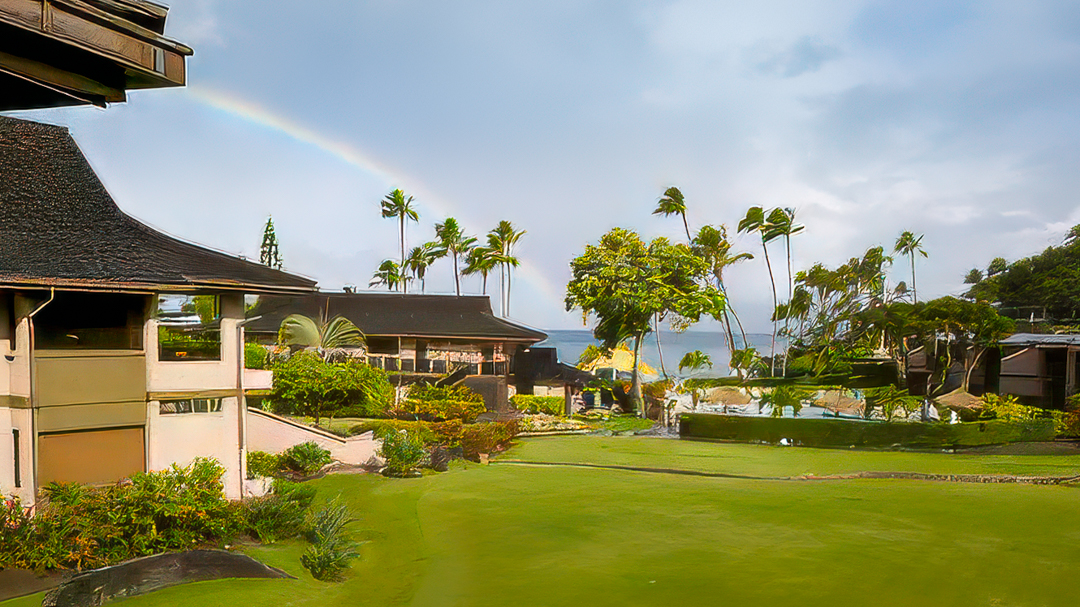
A westerly view from our 2nd floor lanai at 7:56 AM the first morning of our stay just after a brief morning rain shower (26mm, 1/2568 sec, f/1.5, ISO 50)
Our favorite place to relax and refresh is the Napili Kai Beach Resort at the northwest edge of the island (and county of) Maui in the state of Hawaii. And, the resort’s messaging includes (maybe it’s even their ‘motto’) “…discovering the unhurried way of life.” Billie and I stayed there during the last half of May.
I’ve included the below annotated satellite view of the area around our ‘corner’ of Maui (courtesy of Google Maps) and included a tiny insert in the upper-left corner showing all of Maui with a circled star indicating the approximate location of it on the island. In the lower-left of the map you can see Napili Bay identified, as well as the Sea House Restaurant (which is an integral part of the resort property). Just above that, on the map, is the southern entrance to the Kapalua Coastal Trail (just on the northern edge of the resort). That trail heads north following the coast until it reaches the area labeled Ironwood Cliffs, where it turns east and continues to follow the coast until it reaches its end at DT Fleming Beach Park.
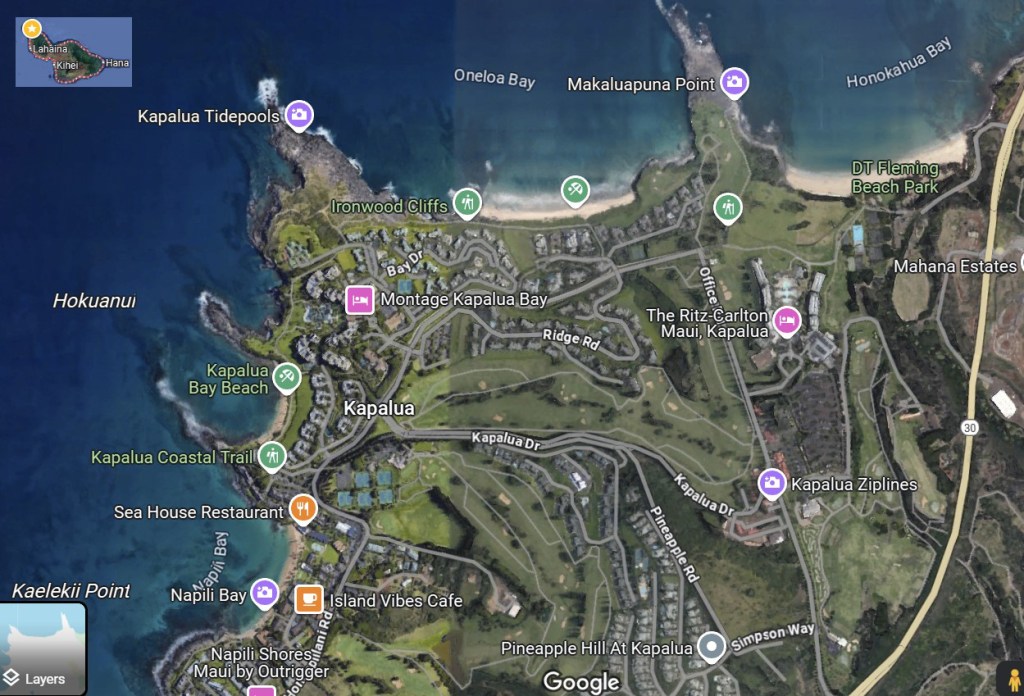
Walking that trail at any time of the day, you will often see other hikers or runners, but more often at the edges of the day, when the temperature might still be at a comfortable low 70 degree’s. I’ve included this view primarily to identify the locations where all the photography shown in this post took place. A few paragraphs below, I also provide a satellite view #2 that provides a bit more close detail of the area at the top-left of this view #1, between Ironwood Cliffs and the Kapalua Tidepools. Although it is not indicated on the map, that area is called Hawea Point and is about a mile or more, from our room.
That first morning of our stay, we were just starting to enjoy our coffee latte’s when I noticed a rainbow, arching out of the ocean. We were not yet completely unpacked and my camera was still tucked away in its backpack, so I just grabbed the phone in my pocket and stepped outside onto the lanai to catch a quick snapshot before the effect disappeared.
By the way, we purchased those morning drinks at the highly recommended Island Vibes Café — just a flight of stairs down, and about a 1/3 mile south from our room for a short ‘wake-up’ walk (opens at 7 AM).
Regular readers of this occasional blog know that most of our travel posts are about my photographic efforts of the trip. This one is not an exception to that focus (no photography pun intended) except, for both of us, this particular trip was more about slowing down, enjoying nature, and connecting with a culture that values balance over busyness (again, “…the unhurried way of life”). Of the 16 days we vacationed at Napili Kai, I only set aside two morning sessions to focus on capturing photographic images.
And, in that regard, instead of aiming for landscape images as I usually do, I spent most of that time working on trying to develop my bird photography skills (an interest I’ve been slowly developing since a photo walk I participated in late last year – see blog post, “Photo walk among the birds“). In support of that effort, I also gave myself a birthday present early this year of a 100-500mm telephoto zoom lens and have been experimenting and learning to use it and my camera in new ways, in my back yard.
Ok, enough of that background, now back to Maui. The very next day after the rainbow photo, I got up early, grabbed my photo backpack and my hiking stick, and well before 6 AM was out the door and heading for the start of the Kapalua Coastal Trail on the other side of the resort. Then I hiked to Hawea Point, where I hoped to find some sea birds to photograph.
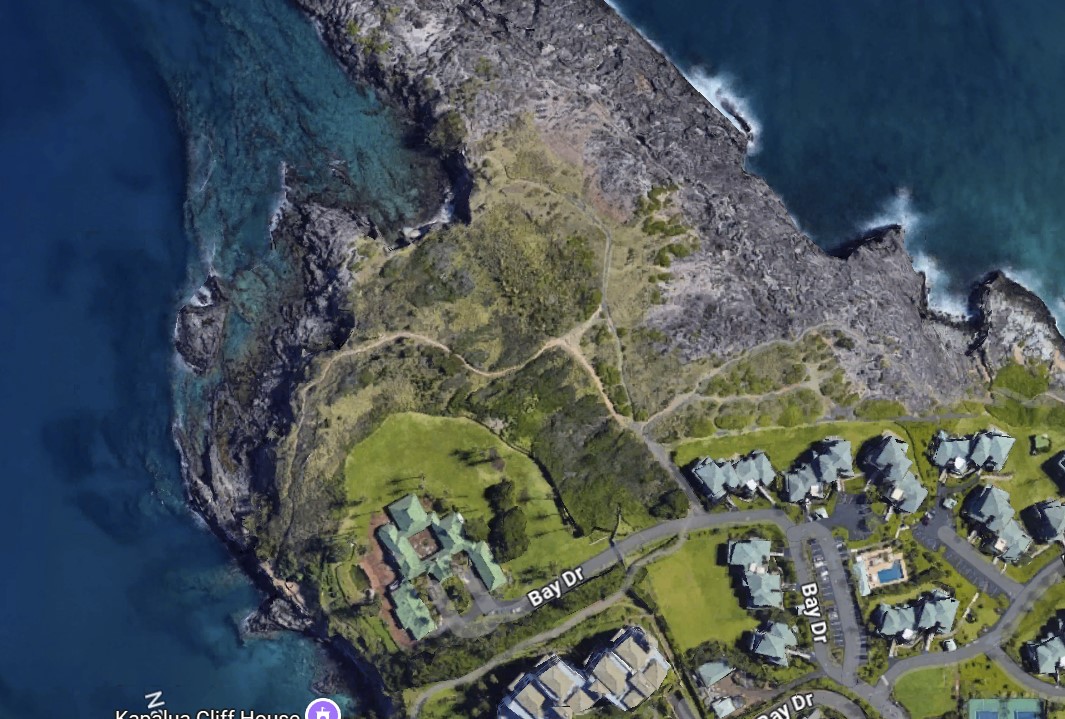
In the satellite map view #2, below, you can just see how the trail comes in (from the bottom-left, next to the water), and then makes a sharp right turn to parallel Bay Drive, and then crosses that street to head into the Hawea Point area. There the trail splits into several different paths, but a few of those merge and continue east (also, see map view #1, above). My target was the area on the point that is flat and not so rocky. A large portion of this area has been set aside as a seabird nesting area reserve. The trails and paths are carefully roped off to encourage people (and controlled pets – no cats, please) to walk only on the marked paths and stay off the nesting grounds. More about the specific birds later in the post.
I spent quite some time exploring the area and looking for birds. I saw a few, mostly sitting on the ground and just one or two flying too far away to photograph. So, I just continued to explore and think about coming back another day. I also climbed on some of the more rocky areas further out toward the tip of the Point (that’s where my hiking stick became most useful) and eventually reached the Kapalua Tidepools. That, of course, tickled the landscape photographer in me and I did take this image of some small waves crashing against the rocky edge of the tidepools. This image was captured at 6:30 AM. As you can see the sun is already up and casting warm morning light on some of the rocks.
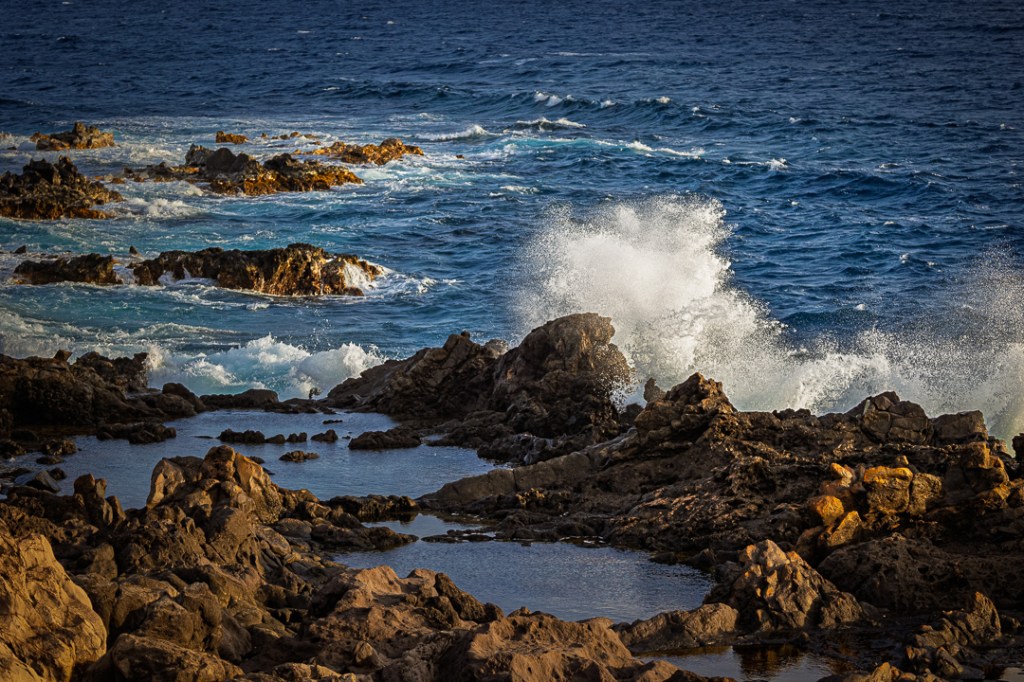
A few days later, during a Hawaiian-culture presentation provided every day by the resort staff (and later supplemented by me doing some online research), I learned that what I had assumed were just naturally formed tidepools were actually built (or modified) by human hands. Most of this building or modification occurred centuries before (probably around the 5th century AD) by early Polynesian (now Hawaiian) natives as a part of their fishing aquaculture. Once put in place, such tidepools would naturally be covered by seawater periodically as a function of tidal shifts, thus trapping fish in the pools to be gathered as needed. This was a more passive, but very affective, version of fishing, in addition to the more active fishing techniques such as line and hook, spears, and nets.
Three days after my first photographic visit to Hawea and after spending some additional time planning my second visit, again I left my room early with my camera and some ideas for hopefully capturing bird images. I’ve already mentioned that a major portion of Hawea Point is a protected (by the state of Hawaii) seabird nesting area. More specifically, it is a nesting area for the Wedge-tailed Shearwater (Ardenna pacifica). Through that continued protection and restoration of the nesting area, this area now supports the largest colony of wedge-tailed shearwater birds on Maui.
The link in the paragraph above provides quite a bit of detail about these birds but in summary, they are a medium-large shearwater in the seabird family. They tend to pair-bond for a few years unless the pair fails at producing offspring. They usually nest in a burrow (either found or dug by both members of the pair). After bonding, they breed, tend to a single egg (for about 50 days, taking turns incubating for multiple days at a time), and raise the chick in the burrow (for up to another 115 days) all of which means that it can take as much as five and a half months before the new chick is ready to leave the nest.
The wedge-tailed shearwater is also an excellent fisher. Nearly 100% of its diet is from the ocean, with about 2/3 being fish and the rest squid and crustaceans. They can gather food from the ocean surface while flying, dip into the ocean to grab something close to the surface, or dive more deeply to reach their prey (they can reach an average maximum depth of 46 feet and more than four times that depth, if necessary).
They also have an unusual call (at least unusual to me) that sounds like a long, low moan. Their Hawaiian name is ‘ua’u kani which means moaning petrel (petrel is another word for seabird). I can remember hiking out to this same area several years ago but much earlier in the morning (before sunrise) and hearing this strange moaning sound apparently coming from the extremely dark ground all around me. I remember wondering if there were any dangerous animals hanging out in the bushes (or was I entering a tropical version of a Harry Potter story).
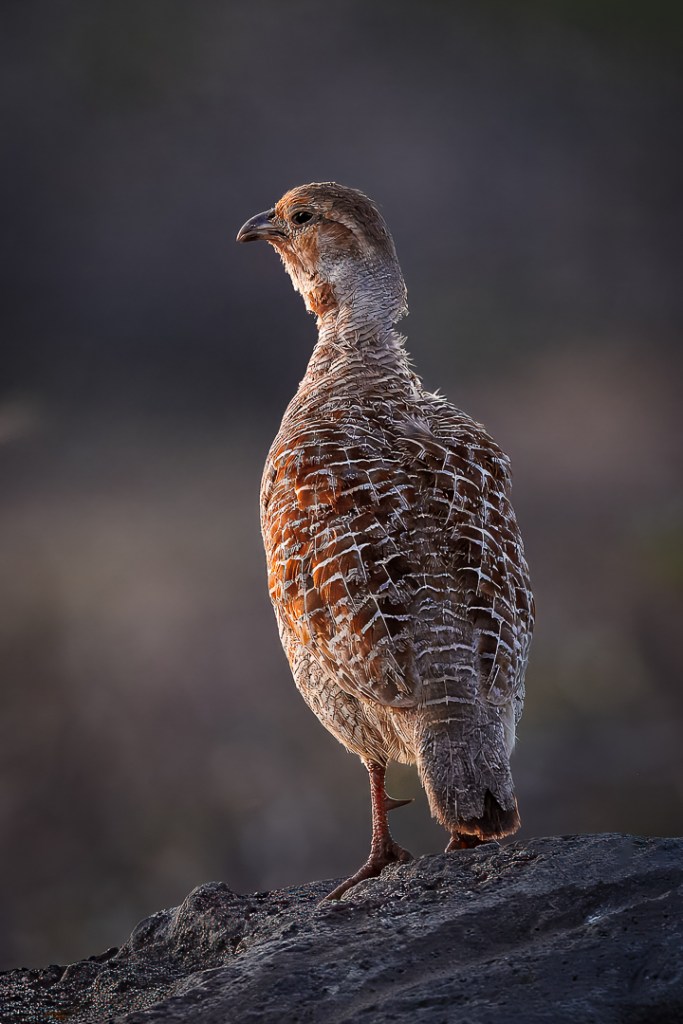
As I began to look around, searching for a photographic subject, I somehow spotted this interesting looking bird (that was definitely not a wedge-tailed shearwater). However, it seemed to be posing for me, standing on that large rock, so I took a photo of it. Later, when I was back at the resort, I asked Mike and Patti (friends from southern California that we met at Napili Kai years ago and now usually see at the resort around this time of year) if they happened to knew what kind of bird this is. And, as I hoped, they were able to identify it for us as a Grey Francolin.
I continued to look around the area, staying only on the marked paths and capturing images of birds on the ground (assuming I’d spend some computer time later, culling out ordinary or possibly spoiled photos, and selecting what I hoped would be the most interesting images worthy of being shared.
This first image that just appealed to me because it showed one of the wedge-tailed shearwater birds seemingly doing some exploring of its own. It appeared to be checking to see if there was anything else already occupying this burrow. Or maybe it was checking on a mate that might have been in the burrow incubating the egg. It even might have been checking on a chick that was not yet ready to learn to fly and seek food for itself. My shooting position was quite distant from the bird (I was utilizing all 500mm of my telephoto lens to get an image that is seemingly so close). Unfortunately, there was no path that would allow me to see over the bird’s shoulder to see into the burrow more deeply, so I’m now just left guessing (and enjoying making up possible scenarios — or anthropomorphic stories).
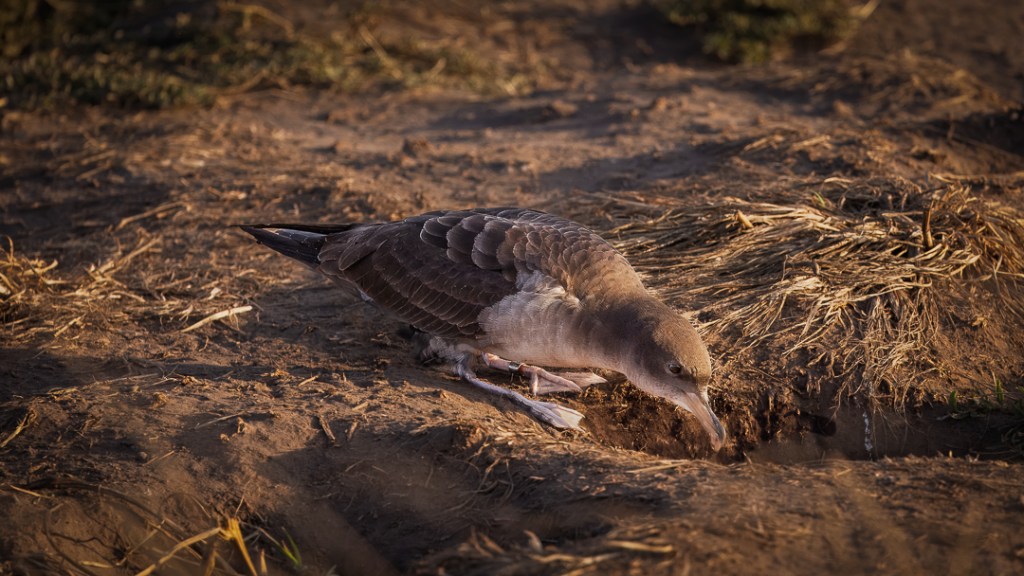
The other thing I like about this photo is that it shows the presence of other burrows close by. And, I didn’t notice it when I captured the image, but this bird is banded; you can just make out a metal band around its left leg. And, finally, I wondered all the while about the bird species’ name; from what I see in this view, the tail isn’t a wedge but a point.
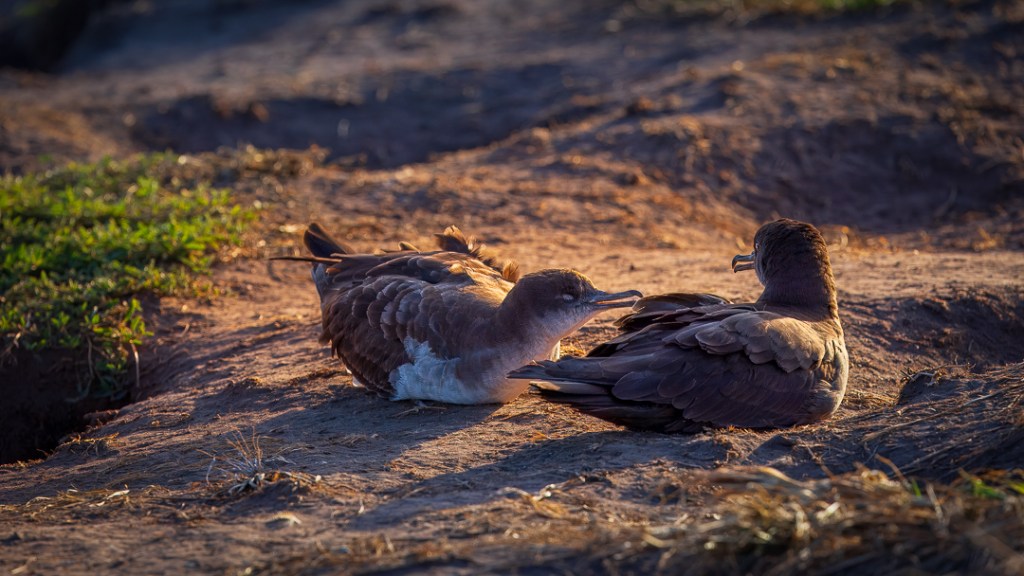
In this second image of the same species, these two were just sitting on the ground, and seemed to be talking to each other. I’ve assumed these two were a bonded pair (but for all I know, they could have been just a couple of guys talking about fishing).
With many bird species, it is possible for people like me to figure out the gender of the birds by their plumage. According to what I’ve read about this species, it comes in two similar colors; either a brown-ish back and white-ish underside or totally brown-ish all over. More importantly, those differences occur in both genders. So, while I’m pretty sure they can identify male and female in each other, I cannot. In this image, like the previous one, you can see evidence of other burrows surrounding the birds.
The next four images are of the same bird over a short period of time. I had been taking pictures all over the area when I spotted one that I thought might be getting ready to fly (just an intuitive hunch, that paid off). So, I pointed my camera at it, and made sure to set my focus and drive to help me follow and photograph a moving subject and to continuously take images as fast as the camera could manage (but before I could push the zoom to make the image tighter, the bird leaped into the air and started beating its wings). It was just about two minutes to 7 AM (which means I’d already had been out shooting for about an hour and a half). It also means I was tired and not as quick as I think I might have been earlier).
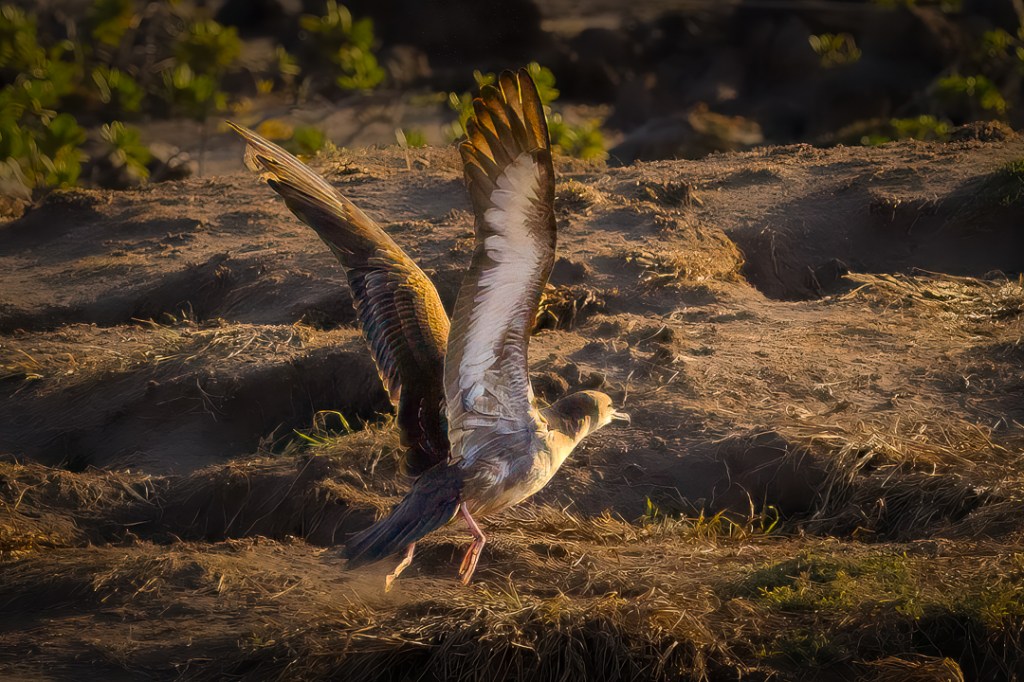
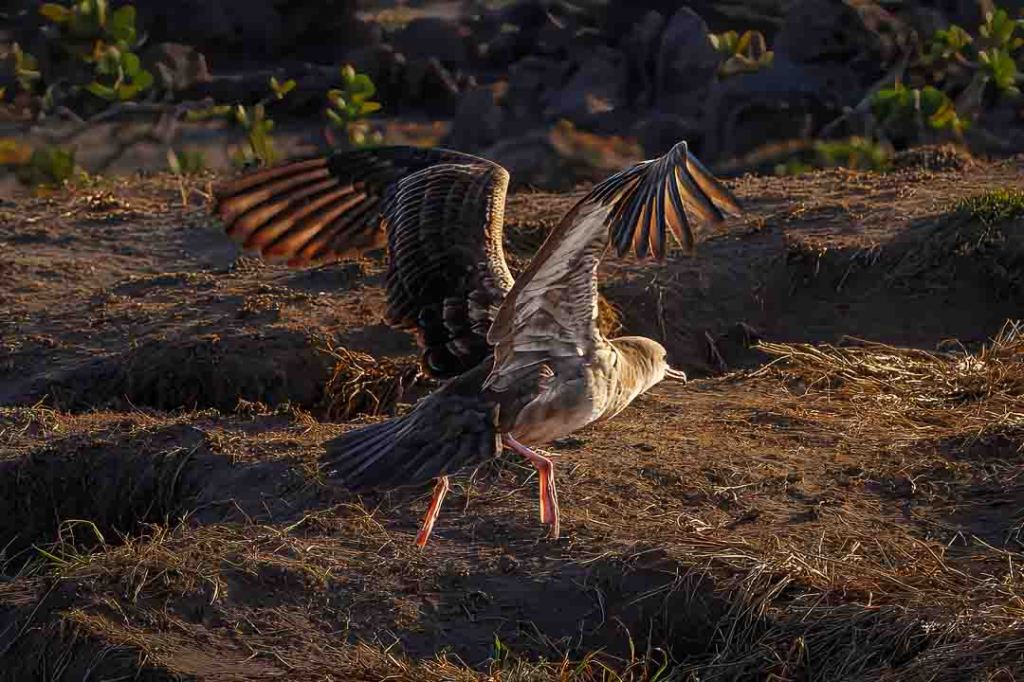
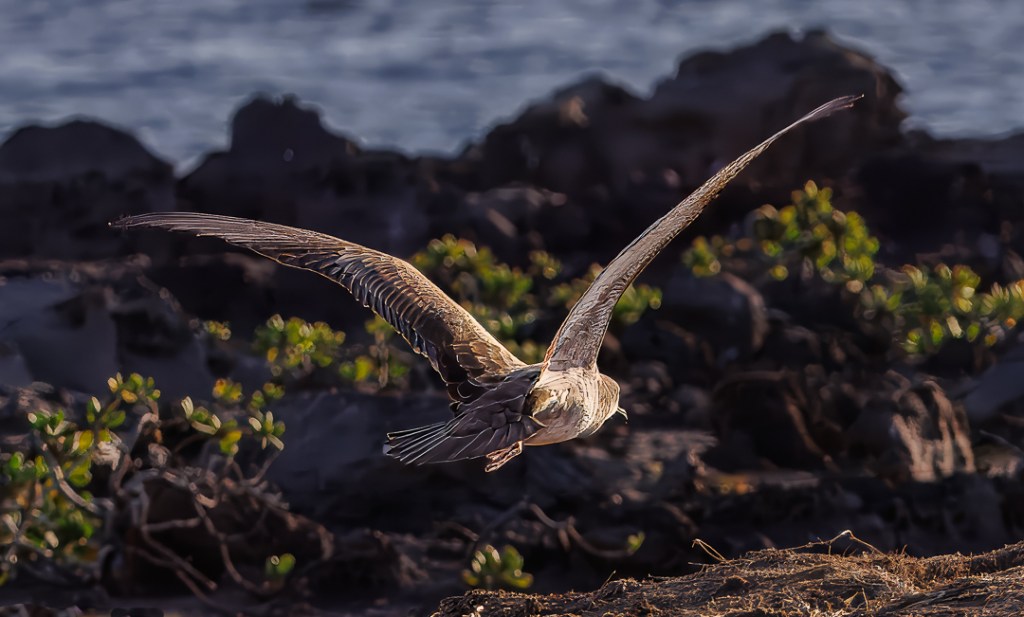
The first three selected images are each, one second apart (the camera was trying to take about 12 images per second) and all (up to) 36 of those photos are about taking off. In the first image, the wings are stretched up, preparing for a downstroke. The second image shows the wings ‘cocked’ (my word — I don’t know the correct terminology) and the feathers at the wing ends (finger feathers?) spread to maximize the downstroke lifting power. The third image either shows the wing captured in the middle of a downstroke or the bird is just gliding a bit.
I learned quite a lot about capturing images of birds in flight in this brief, but exciting shooting session. I also finally realized why the birds are called wedge-tailed; the shape of those tail feathers are very clear when the bird is seen in flight and at the right angle. When the birds are standing or sitting on the ground, those huge, beautiful wings are folded back and over lapped, making the back look like it is pointed, and not wedge-shaped.
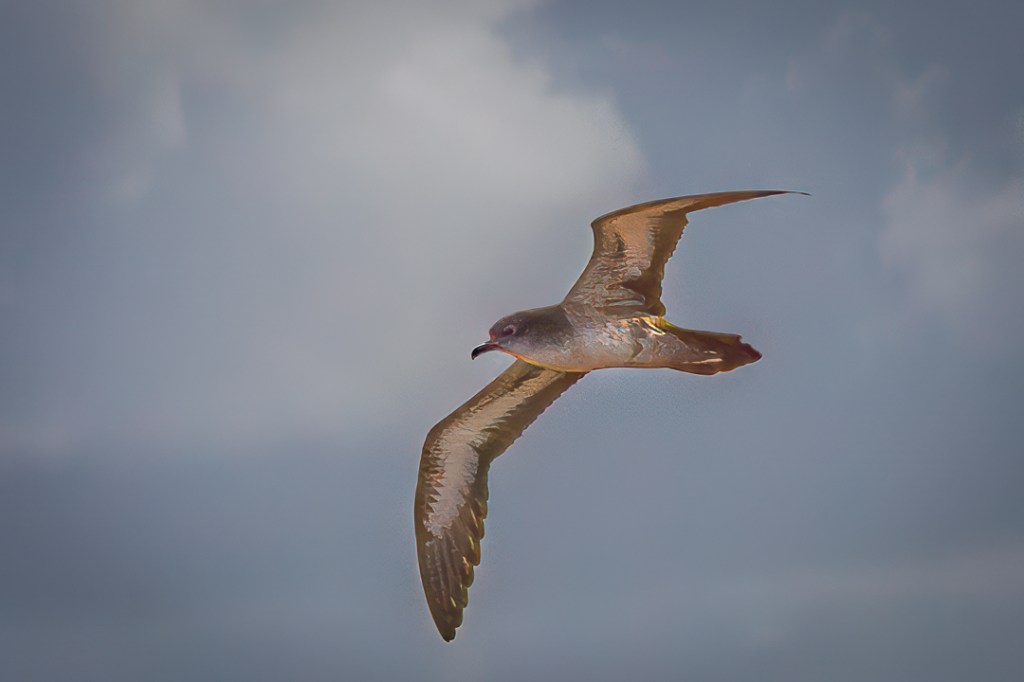
flying over the ocean, near Hawea Point, Kapalua Coastal Trail, Maui (145mm, 1/1600, f/7.1, ISO 200)
This fourth image was taken only 13 seconds after the third. The camera even lost focus a couple of times during the continuous photography burst, (we -the camera and me- reacquired focus, each time). It probably would have done better if I’d managed to zoom to a tighter composition — but in the rush, I didn’t. The reason the birds in these latter shots look the same size as the earlier images is because I was able to severely crop them during post-processing to appear as tighter compositions and still have them look well-focused.
When I was done (over many days, later) selecting possible images to process, and was eventually satisfied with the post processing results (which were finally completed after we’d returned home), I was able to delete the other (about 250) unused exposures. That 16 seconds of shooting certainly gave me a rush and I began to understand the attraction of trying to photograph birds, especially those in flight!
NOTES
Note 1: Thank you for taking a look at this post. I hope you enjoyed it, the images, and my occasional attempts at humor. If you would like to see these images somewhat larger and with greater photographic detail and color fidelity, just click on this link to my photo website and the What’s New section or use this Flickr link to my 2025 Album. There you will find all of the above images as well as the ability to just click to see them larger. If you agree with any of my choices or find something in my collections that you like better, you can always let me know by commenting in the Reply section below or by leaving a comment on the photo itself while viewing them in my photo website or Flickr site.
Note 2: My wife believes that this post cannot be complete without a brief report on the status of Maui from our perspective. I don’t disagree but probably would not have written this part without her encouragement. I can tell you that we do not drive around looking for what’s changed. We also, don’t ask locals about the catastrophe or how it affected them (imagine yourself as someone who survived what they survived and how you might feel if people you don’t know, or barely know, keep asking about it). We know how we would feel, so we don’t do it to them.
On the other hand, we do drive to and from the airport and to restaurants and stores not on the resort property. We know some of the resort staff fairly well and sometimes they choose to talk with us about how they are doing and how they were affected. In that context, we are invited to ask questions (within limits, of course)
With all those caveats and our disclaimer that this is only our impression and opinion and not a carefully researched report, here is what we think:
Things definitely feel better than they did a year (and more) ago. That general ‘aloha’ friendly feeling seems to be coming back, particularly at the resort but also in stores and other public places. Basic infrastructure is in place and working. Areas of destruction which were fenced off or otherwise kind of kept out of sight are now uncovered and most (all?) of the visible destruction has been removed, lots smoothed over, and unfenced. Some new buildings have been constructed and installed and seem to be a bit more up-to-date while maintaining native-looking designs. Here and there, newer residences under construction can be seen.
It is our feeling, and general opinion that central support (state, federal, and other) has been fairly bogged down, slow, and bureaucratic. There is still a lot of general sadness throughout the population. Nearly everyone has lost family or other people close enough to be considered family. And an incredible amount of rare and historical artifacts and buildings have been destroyed. The general lack of central and focused early support has added to the unhappiness.
Summary: It seems to be getting better, but somewhat slowly. Staff who discussed it with us are anxious to see tourism increase to previous levels or above.
Note 3: If you enjoy reading these occasional posts you might consider subscribing to this blog (generally no more than five or six posts per year and sometimes far fewer, so email boxes are not being overly clobbered by my stuff).
To subscribe is easy. You may have noticed while reading a post, that anytime you scroll up a little, a dialog bar will appear in the bottom, right-hand, corner of wherever you are in the post. And that dialog bar will include the word Subscribe. [It may also include two other words (“Comment” and “Reblog” plus a “…” option)]. If you click on the “Subscribe” word, another dialog will appear, just asking for your email address. Once you complete that process, you will likely receive another communication asking you to confirm your subscription.
That’s it. Then whenever a new post is published you will receive an email letting you know. It will include the post’s title (linkable, directly back to the full post, in the blog), and first few lines of the actual post text. If the post includes a “featured photo” (a picture at the very beginning of the post, which nearly all of mine do) it is also included.

 Ced's Blog